Browsing News Entries
Pope’s visit to Peru: A source of hope for a people seeking peace
Posted on 08/5/2026 08:49 AM ()
Ahead of Pope Leo XIV’s visit to Peru from 11 to 17 November, Cardinal Carlos Castillo, Archbishop of Lima, speaks of the joy with which the Church and the Peruvian people are awaiting the Holy Father.
Pope encourages Catholics to deepen prayer through Liturgy of the Hours
Posted on 08/5/2026 08:30 AM (USCCB News Releases)
VATICAN CITY (CNS) -- Returning to his weekly general audiences after a monthlong summer break, Pope Leo XIV urged Catholics to embrace the Liturgy of the Hours more fully in their daily lives, saying the church's public prayer is an antidote to a world shaped by technology, consumerism and an efficiency-driven mindset.
"Every week and every day, the Eucharist and the Liturgy of the Hours are the breath of the life of the Church, which makes the Holy Spirit circulate through her Body," he said Aug. 5.
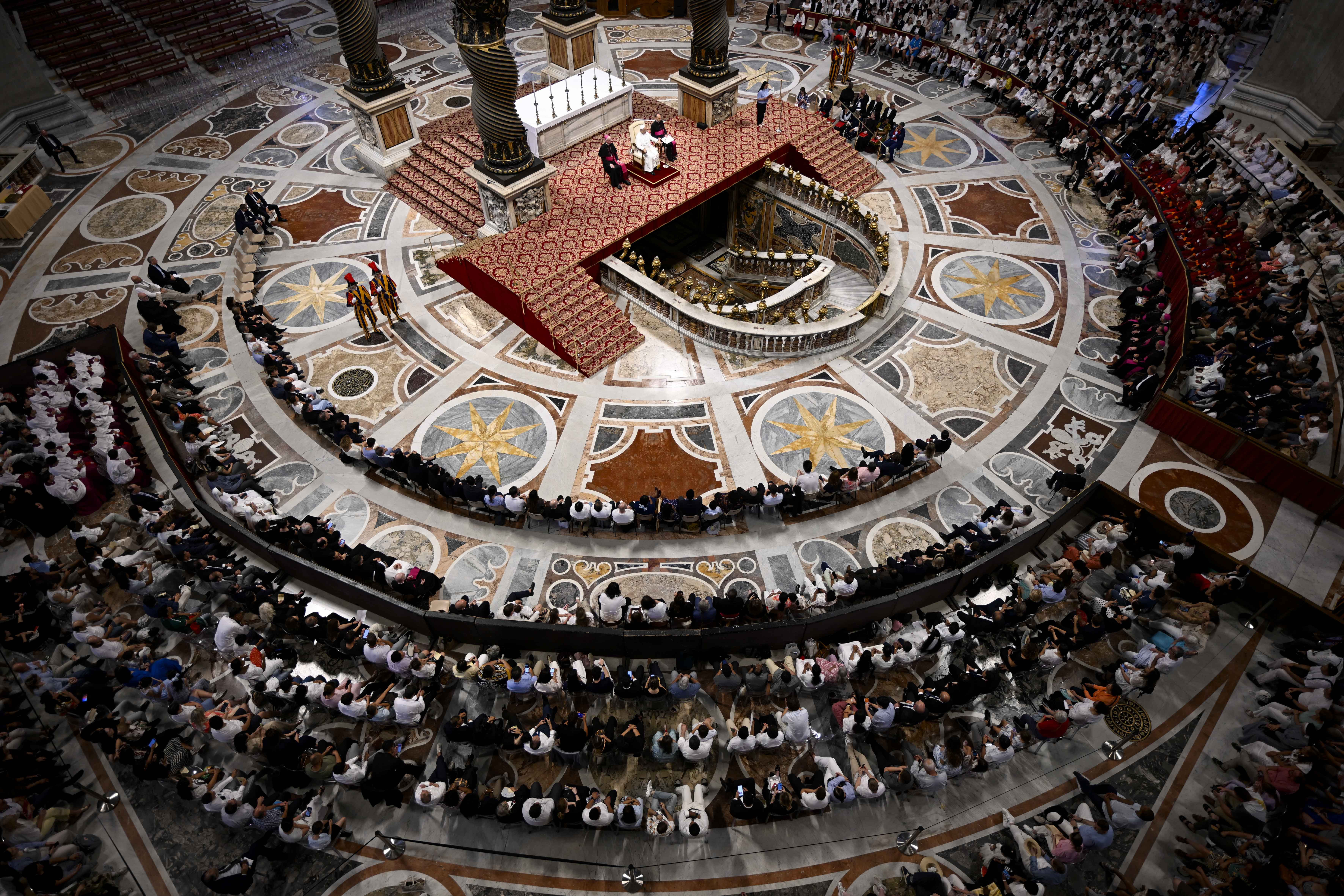
Because of Rome's summer heat, the pope held the audience inside instead of St. Peter's Square; however, this time it was held in St. Peter's Basilica rather than in the Paul VI Hall. As he processed to the altar, he stopped to shake hands with attendees and bless babies and rosaries.
Continuing his series on the documents of the Second Vatican Council, Pope Leo reflected on 'Sacrosanctum Concilium,' the Constitution on the liturgy. He said "it is the Holy Spirit who teaches us to pray," and that Christians unite themselves with Christ in offering praise and thanksgiving to God through the power of the Holy Spirit.
Bound to the Eucharist, the Liturgy of the Hours sanctifies the rhythm of the day, the pope said, beginning with morning prayer, continuing at midday and evening, and ending with night prayer as the faithful entrust themselves to God's peace.
"Each hour is an act of hope," he said.
The Liturgy of the Hours is the church's official daily prayer, consisting of psalms, Scripture readings, hymns and prayers recited at designated times throughout the day. Pope Leo said the tradition of prayer is "no longer passed on" even in many Christian families, even though prayer is a "fundamental dimension of our humanity."
In societies "dominated by an efficiency-driven and consumerist mindset," prayer can seem "pointless and trivial," the pope said. In a world "where science and technology claim to provide all the answers," he added, prayer may appear to be a form of escapism.
"Brothers and sisters, may we find the spiritual nourishment necessary on our earthly pilgrimage by joining with the whole Church in her liturgical prayer as we await the coming of our Lord Jesus Christ," the pope said in his greeting to English-speaking pilgrims.
"Far from avoiding the world and its needs, all prayer, especially in the entire liturgy, is the essential dimension of our humanity," he added.
The pope's encouragement comes after the Vatican approved a new English-language edition of the Liturgy of the Hours in November 2025. After 13 years, the U.S. bishops produced a translation that more closely reflects the original Latin texts. The first volume is expected to be released ahead of Lent 2027.
In his greeting to French-speaking pilgrims, Pope Leo encouraged those on summer vacation to deepen their interior life by spending more time with the Lord in prayer. Even leisure and rest, he said, "belong to him" and "can be sanctified by his presence."
Bishop Garcia Underscores the Significance of the Voting Rights Act and Encourages Recommitment to the Work Which Remains
Posted on 08/5/2026 08:30 AM (USCCB News Releases)
WASHINGTON - The Voting Rights Act was signed into law on August 6, 1965. The landmark legislation helped advance equal access to the ballot and strengthened participation in our democracy. In recognition of the six decades since it was enacted, and its continued significance today, Bishop Daniel E. Garcia, chairman of the U.S. Conference of Catholic Bishops’ Subcommittee for the Promotion of Racial Justice and Reconciliation issued a statement.
“The Voting Rights Act of 1965 emerged from the sacrifices and perseverance of countless individuals who worked to secure the fundamental right to vote, particularly for communities of color that had long faced discrimination and exclusion.
“Today, many communities of color worry about how recent developments will impact their fair representation and future participation in the democratic process. Echoing our Holy Father, Pope Leo XIV, we affirm the value of democracy ‘insofar as it guarantees the effective participation of citizens’ as a reflection of their dignity.1 For decades, the U.S. bishops have advocated for the right of eligible citizens to participate fully in public life, including the protection of voting rights.2 We encourage all citizens to exercise their right to vote and urge policymakers to safeguard voting rights and promote fair representation for all. Today is also an occasion to remember the hard-won history of voting rights in our country, and to recommit to the work which remains.
“May we continue to work together for the common good and for a society in which all citizens are able to participate fully and faithfully in our democracy.”
###
SIGNIS World Congress 2026: communication at the service of peace
Posted on 08/5/2026 06:18 AM ()
Being disciples before influencers, giving a voice to the voiceless, addressing the anthropological challenges posed by artificial intelligence, safeguarding children in the digital environment, and promoting peace and care for creation were among the central themes of the first plenaries and panels of the SIGNIS World Congress taking place in Kigali, Rwanda.
St. Addal: Saint of the Day for Wednesday, August 05, 2026
Posted on 08/5/2026 06:00 AM (Catholic Online > Saint of the Day)
Pope Leo to visit Uruguay, Argentina and Peru in November
Posted on 08/5/2026 04:00 AM ()
The Holy See Press Office announces that Pope Leo will make an Apostolic Journey to Uruguay, Argentina and Peru in November 2026.
Pope mourns Mozambique's Cardinal Langa, who "proclaimed peace"
Posted on 08/5/2026 03:36 AM ()
Pope Leo sends a telegram to Archbishop Chimoio, Apostolic Administrator of Xai-Xai in Mozambique, expressings his spiritual closeness following the death of Cardinal Langa, who devoted himself “with simplicity, zeal and perseverance to the flock entrusted to him, without allowing himself to be discouraged by difficulties.”
Pope at Audience: Prayer is an act of hope
Posted on 08/5/2026 02:53 AM ()
Pope Leo delivers his fifth catechesis on Sacrosanctum Concilium, the Second Vatican Council’s Constitution on the Liturgy, reflecting on the ecclesial dimension of liturgical prayer and describing the liturgy as “the place of encounter, of God’s initiative in drawing near to humanity in His Son”.
Pope to Knights of Columbus: Be prophets of harmony in an age of division
Posted on 08/4/2026 14:00 PM ()
Pope Leo urges the Knights of Columbus to be “prophets of harmony” by fostering unity through dialogue, and serving those most in need through works of charity.
Lebanon’s children hit hard by overlapping crises
Posted on 08/4/2026 10:10 AM ()
In recent months, children in Lebanon have been bearing the brunt of the country's compounded crises, facing alarming rates of casualties, mass displacement, severe food insecurity, and deep psychological trauma.